A 20-pound bag of “senior formula” kibble does nothing for a dog who can no longer comfortably crush kibble. The bag isn’t wrong — it’s just answering a different question than the one a toothless or few-toothed senior actually needs answered.
This guide is written and fact-checked by Dr. Sanjeev Kumar, a USA-based veterinarian who reviews product formulations before they’re added to any BestDog.Food list, with every product below verified against its current Amazon.com listing.
Best dog food for older small dogs with few teeth generally means a complete and balanced diet with a soft, pate-, loaf-, or mousse-style texture that requires little to no chewing.
Calorie density should also fit a smaller, often less active senior body — not just the texture.
Small breeds are disproportionately prone to periodontal disease as they age. By the time many owners notice missing teeth, the dog has usually already adjusted how — and whether — it eats.
Modern feeding guidance from AAFCO and WSAVA has moved away from “just soften the same bag.”
The current approach matches texture, moisture, and nutrient adequacy to the individual dog’s mouth, appetite, and body condition — not just its age on paper.
Quick Answer
The short version
For most older small dogs with few remaining teeth, a pate-style canned senior formula is the safest starting point. It needs no chewing, has high moisture for hydration, and is easy to portion for a small body.
Hill’s Science Diet Adult 7+ Chicken & Barley Entrée is our Best Overall pick, for its smooth loaf texture and small-dog-friendly can size.
If your dog still has a few molars and you want to mix in softened kibble instead, Hill’s Science Diet Adult 7+ Small Bites softens well in warm water.
Always confirm with your vet whether a specific dental or health condition changes this recommendation.
| Looking for the single easiest texture to eat | → Hill’s Science Diet Adult 7+ Chicken & Barley |
| Extra-small or toy-breed senior (under 10 lb) | → Royal Canin Small Aging Wet Pouch |
| Budget-conscious, still complete and balanced | → IAMS Proactive Health Senior |
| Dog with stiff joints or mobility loss | → Blue Buffalo Homestyle Senior 7+ |
| Small portions that don’t waste a big can | → Hill’s Science Diet Small & Mini Trays |
| Still has some molars, wants kibble softened | → Hill’s Science Diet Adult 7+ Small Bites |
- Confirm the exact can/tray size before comparing prices — small-dog packaging varies a lot between brands.
- Check the AAFCO nutritional adequacy statement on the current listing; formulas do get reformulated.
- Check calorie density (kcal/can) if your dog needs weight control, not just soft texture.
- Verify the exact formula name — “Senior,” “Senior 7+,” and “Small & Mini” versions of the same brand are not interchangeable.
- If your dog has a diagnosed condition (kidney, heart, diabetes), confirm this formula doesn’t conflict with a prescription diet.
- Re-check the ingredient panel against any known food sensitivity before switching.
- Plan a gradual transition — abrupt food changes can upset a senior dog’s digestion more than a younger dog’s.
How We Selected These Foods
Every product below is currently listed on Amazon.com with a verified ASIN, formula name, and can/tray size. We did not link to a different recipe, size, or life-stage variant than the one actually discussed.
We prioritized a soft, minimal-chew texture — pate or loaf, rather than chunks-in-gravy, which can still require some tearing.
We also looked for a formula labeled for senior or all-life-stage adult maintenance with a visible AAFCO adequacy statement.
Package sizing realistic for a small dog mattered too, so an open can doesn’t sit in the fridge for a week, along with ingredient transparency from an established, traceable manufacturer.
We did not rank based on price, and no manufacturer had input into placement. Products that lacked a current, verifiable Amazon.com listing were dropped rather than included with placeholder information.
“Few teeth” is not one condition. A dog missing four back molars after a dental cleaning eats very differently from a dog with advanced periodontal disease and loose front teeth.
The right food depends on which teeth are gone, whether gums are inflamed, and whether your vet has flagged anything that needs a texture even softer than pate.
When in doubt, ask your vet to watch your dog eat a small test portion before you commit to a full case.
Comparison Table
| Pick | Best For | Format | Life Stage | Key Decision Factor | Main Trade-Off |
|---|---|---|---|---|---|
| Hill’s Science Diet Adult 7+ Chicken & Barley | Best Overall | Canned, smooth loaf | Senior 7+ | No-chew texture, widely available | Not small-breed-specific portioning |
| Purina Pro Plan Adult 7+ Chicken & Rice | High-Protein Senior | Canned pate | Senior 7+ | Higher protein for lean muscle upkeep | Richer — introduce gradually |
| IAMS Proactive Health Senior | Best Value | Canned, classic ground | Senior 7+ | Lower cost per case | Less calorie-dense per can |
| Blue Buffalo Homestyle Senior 7+ | Joint Support | Canned pate | Senior 7+ | Added glucosamine/chondroitin | Contains carrageenan; some dogs react |
| Royal Canin Small Aging Wet Pouch | Toy/Extra-Small Seniors | Pouch, soft texture | Small breed, aging 8+ | Portioned for very small dogs | Smaller pouches cost more per ounce |
| Hill’s Science Diet Small & Mini Trays | Small Portions | Tray, chicken & vegetables | Senior 7+, small/mini | Right-sized so nothing wastes | Higher per-ounce cost than large cans |
| Hill’s Science Diet Adult 7+ Small Bites | Softenable Kibble | Dry, small kibble | Senior 7+ | Softens in warm water/broth in minutes | Not suitable if chewing is painful at all |
Nutrition & Formula Snapshot
Figures below reflect the guaranteed-analysis ranges published on each product’s current label.
These are as-fed values, not dry-matter comparisons. Wet and dry foods shouldn’t be compared on protein percentage alone, because moisture content differs dramatically between them.
| Food | Format | Texture | AAFCO Life Stage | Practical-Fit Note |
|---|---|---|---|---|
| Hill’s Science Diet Adult 7+ Chicken & Barley | Canned, 13 oz | Smooth loaf | Adult maintenance, senior-labeled | Single-dog practical; large enough to share across 2 small meals |
| Purina Pro Plan Adult 7+ Chicken & Rice | Canned, 13 oz | Pate | Adult maintenance, senior-labeled | Single-dog practical |
| IAMS Proactive Health Senior | Canned, 13 oz | Classic ground | Adult maintenance, senior-labeled | Bulk/multi-dog practical for the price tier |
| Blue Buffalo Homestyle Senior 7+ | Canned, 12.5 oz | Pate | Adult maintenance, senior 7+ labeled | Single-dog practical |
| Royal Canin Small Aging Wet Pouch | Pouch, single-serve | Soft loaf/mousse | Small breed, aging | Travel-friendly; ideal for under-15 lb dogs |
| Hill’s Science Diet Small & Mini Trays | Tray, 3.5 oz | Chicken & vegetables, soft | Adult maintenance, senior small/mini | Topper-friendly; single-meal portion for toy breeds |
| Hill’s Science Diet Adult 7+ Small Bites | Dry, 5 lb bag | Small kibble, softens in liquid | Adult maintenance, senior-labeled | Small-storage friendly; softening adds a step |
The decision variable: how much chewing your dog can still comfortably do.
The trade-off: canned pate needs zero chewing but costs more per calorie and spoils faster once opened. Softened kibble is cheaper per calorie and stores easily as a dry bag, but still requires some tongue-and-gum mashing that isn’t appropriate for every mouth.
Who prefers canned: dogs with visibly inflamed gums, very few remaining teeth, or recent extractions.
Who prefers softened kibble: dogs who still have several molars and simply chew more slowly than they used to.
Verdict: choose canned pate when chewing looks uncomfortable at all; choose softened kibble when the dog is managing dry food, just more cautiously than before.
7 Best Dog Food for Older Small Dogs With Few Teeth
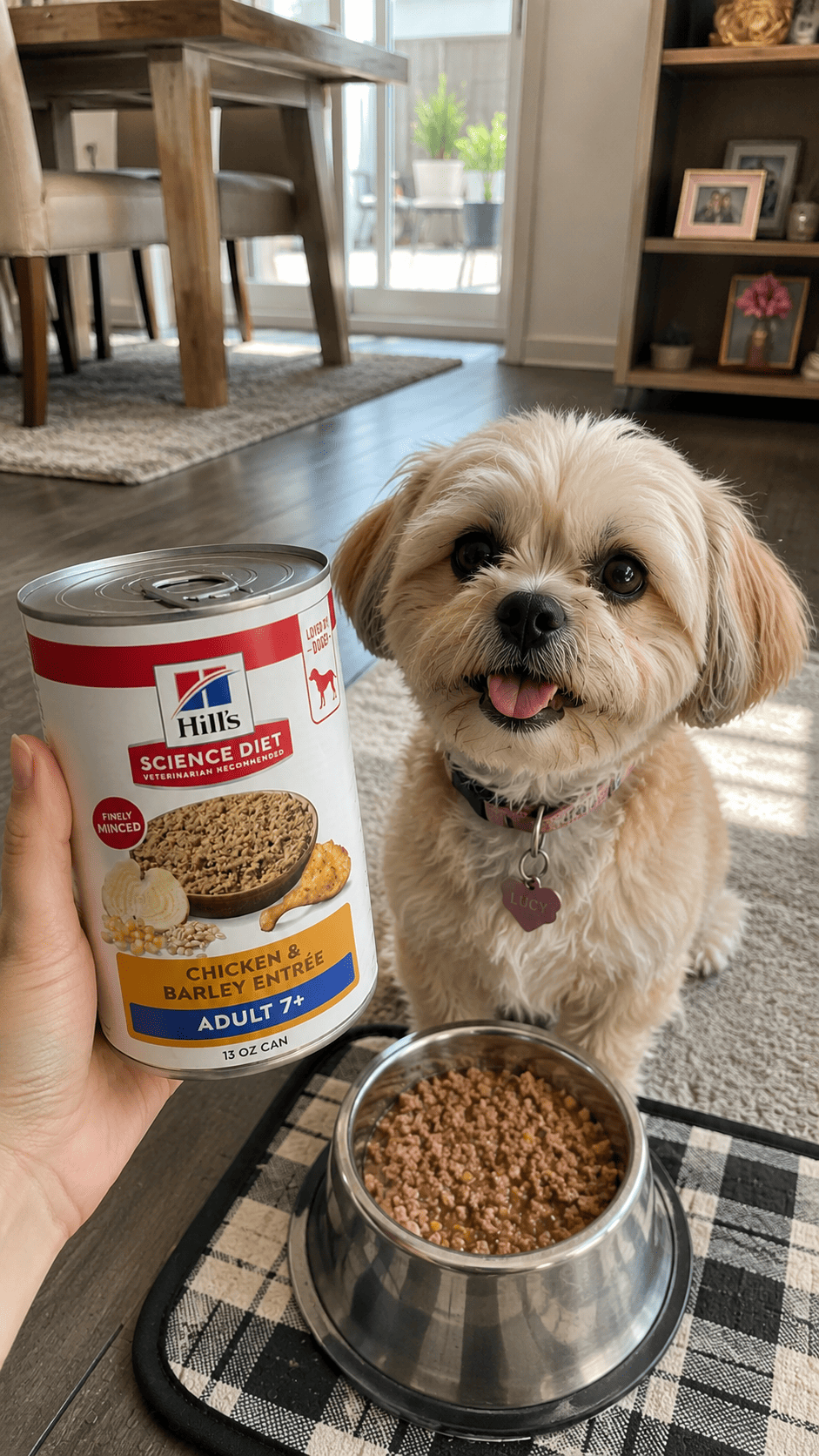
Hill’s Science Diet Adult 7+ Chicken & Barley Entrée
Canned, 13 oz — verified current Amazon.com listing
- Smooth loaf, no chunks to bite through
- Widely stocked, easy to reorder
- Real chicken as the first ingredient
- 13 oz can is generous for a single small meal
- Not marketed as small-breed-specific
Why we picked it: the loaf consistency is one of the smoothest in this category, which matters more than brand reputation once a dog genuinely cannot chew.
Hill’s cooks water, chicken, and cracked pearled barley into a uniform senior loaf.
There’s no gravy-and-chunks separation to sort through — that matters for a dog relying on its tongue more than its teeth.
The texture is consistent can to can, which cuts down on the guesswork of whether today’s can will be chewable.
The 13 oz can is sized more for a medium adult dog’s daily intake than a 9-pound senior’s — expect to portion and refrigerate the rest.
Check the current calorie-per-can figure on the listing against your dog’s actual needs rather than assuming.
The current listing shows this formulated to AAFCO adult maintenance standards. Confirm the senior-specific claims on the exact can you receive, since Hill’s runs several parallel Adult 7+ lines.
Purina Pro Plan Adult 7+ Chicken and Rice Entrée
Canned, 13 oz — verified current Amazon.com listing

- Higher-protein formulation for lean muscle upkeep
- No corn, wheat, soy, or artificial colors
- Research-backed manufacturer with published feeding standards
- Richer recipe — some dogs need a slower transition
- Not formulated for renal or cardiac restriction
Why we picked it: this is one of the few senior-labeled cans that explicitly targets lean-muscle maintenance rather than just calorie delivery.
Muscle loss (sarcopenia) is common in aging small dogs, and a soft texture alone doesn’t address it — protein quality does.
Pro Plan’s 7+ Chicken and Rice formula leads with real chicken and is built specifically for the 7-and-older window.
It sits within Purina’s broader senior lineup, so there are related formulas if your dog’s needs shift later.
Richer, protein-forward wet foods can move through a sensitive senior gut faster than a plainer recipe.
Transition it gradually and watch stool consistency for the first week.
Verify the current AAFCO statement and calorie count on the listing, since Purina periodically updates specific formula parameters.
The decision variable: whether your dog is losing visible muscle over its topline and hips, or simply eating less overall.
The trade-off: higher-protein senior formulas support muscle retention but can be richer than a dog’s digestion is used to.
Who prefers higher-protein: dogs with visible muscle wasting and no diagnosed kidney or liver disease.
Who prefers a standard formula: dogs who are eating fine and simply need the texture change.
Verdict: the better fit depends on whether the underlying problem is “can’t chew” or “can’t maintain muscle” — they’re not the same problem, and a vet exam can tell you which one you’re actually solving.
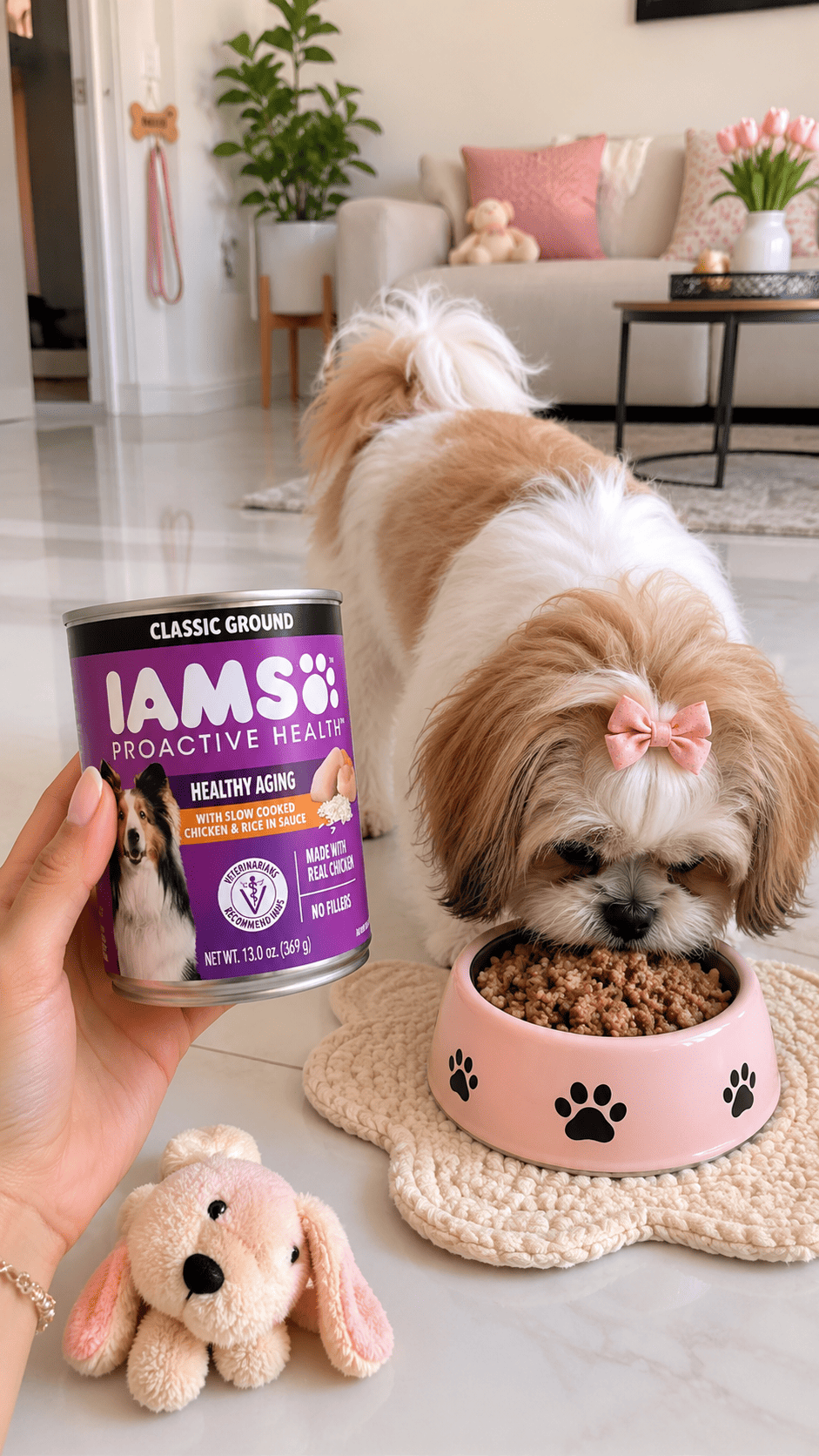
IAMS Proactive Health Senior Wet Dog Food, Chicken and Rice
Canned, 13 oz — verified current Amazon.com listing
- Lower cost per case than most competitors here
- Classic ground texture is easy to mash further if needed
- Contains glucosamine and chondroitin sources
- Some owners report needing to feed a larger volume per meal
- Ingredient panel includes more processed components than premium picks
Why we picked it: it’s the most accessible price point in this list that still meets a complete-and-balanced senior standard with a soft, mashable texture.
“Budget” and “nutritionally adequate” aren’t opposites. IAMS’ Healthy Aging line is formulated specifically for dogs seven and older, with real chicken listed first.
The classic ground texture presses flat easily between two fingers — a good practical test for whether it’s soft enough for your specific dog.
It’s less calorie-dense than some premium cans, so very small or low-appetite dogs may need slightly more volume to meet daily needs.
Check the current label’s calorie-per-can figure.
Confirm the AAFCO adequacy statement and ingredient list on the listing before ordering, since formulas can be updated between production runs.
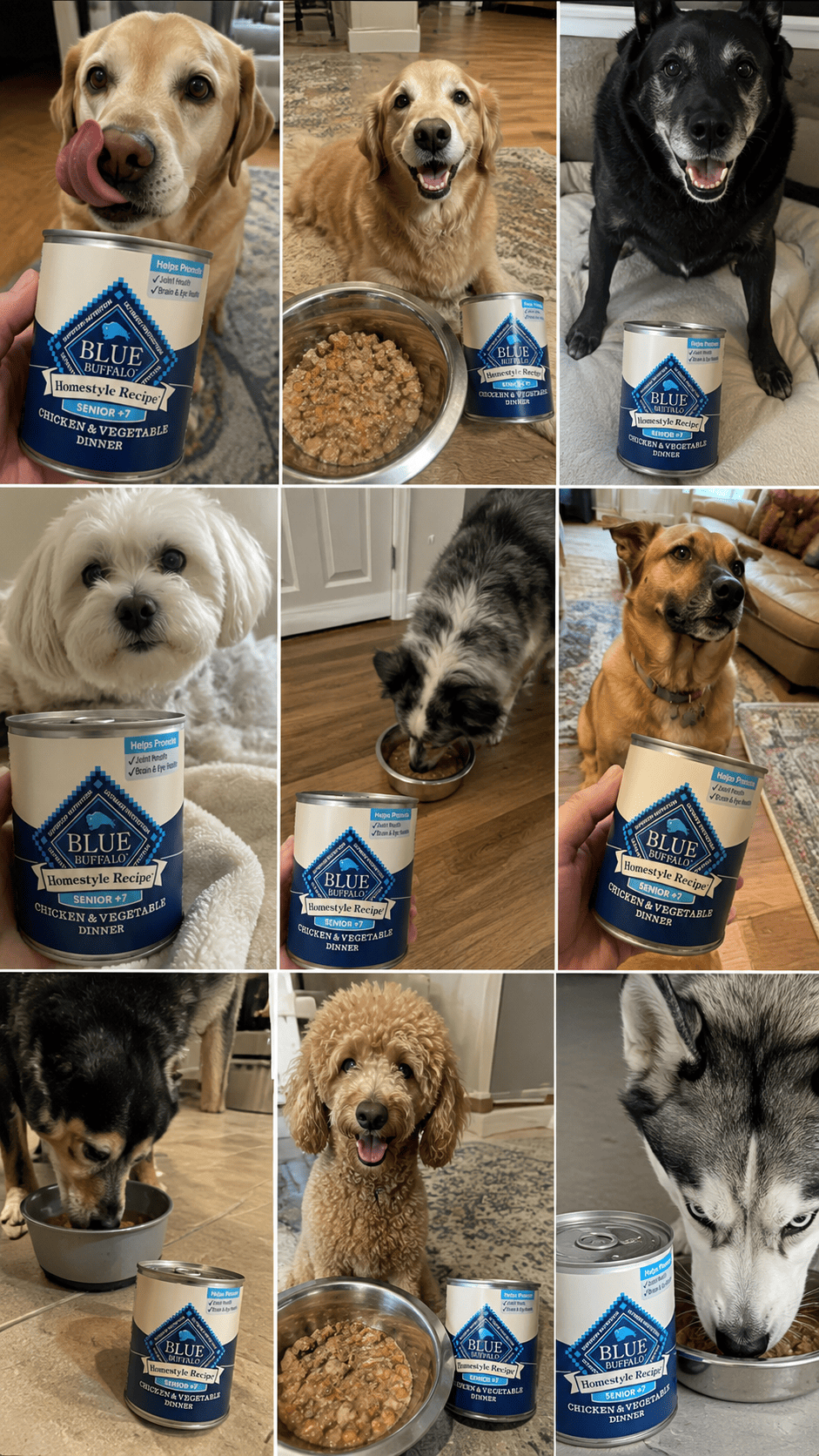
Blue Buffalo Homestyle Recipe Senior 7+ Chicken & Vegetable Dinner
Canned pate, 12.5 oz — verified current Amazon.com listing
- Added glucosamine and chondroitin for joint support
- No poultry by-product meal, corn, wheat, or soy
- Real chicken listed first
- Contains carrageenan, which some owners choose to avoid
- Vegetable pieces are soft but not fully pureed
Why we picked it: it’s the clearest option here for a dog dealing with both dental loss and joint stiffness at the same time — a very common senior-dog combination.
Aging small dogs frequently deal with dental disease and early joint changes in the same window of life.
This formula is one of the few senior-labeled cans that addresses both, with glucosamine and chondroitin built in rather than a separate supplement.
The pate base is soft, though the vegetable pieces (carrots, peas, sweet potato) are small rather than fully smooth — worth mashing further for a dog with zero chewing ability.
It uses carrageenan as a texturizer. That’s generally regarded as safe in pet food, but it’s one some owners prefer to avoid — check the current ingredient list if this matters to you.
Formulated to meet AAFCO nutrient profiles for senior dogs 7 and up per the current listing — verify this hasn’t changed before ordering a large case.
Royal Canin Small Aging Wet Dog Food Pouch
Pouch, single-serve — verified current Amazon.com listing
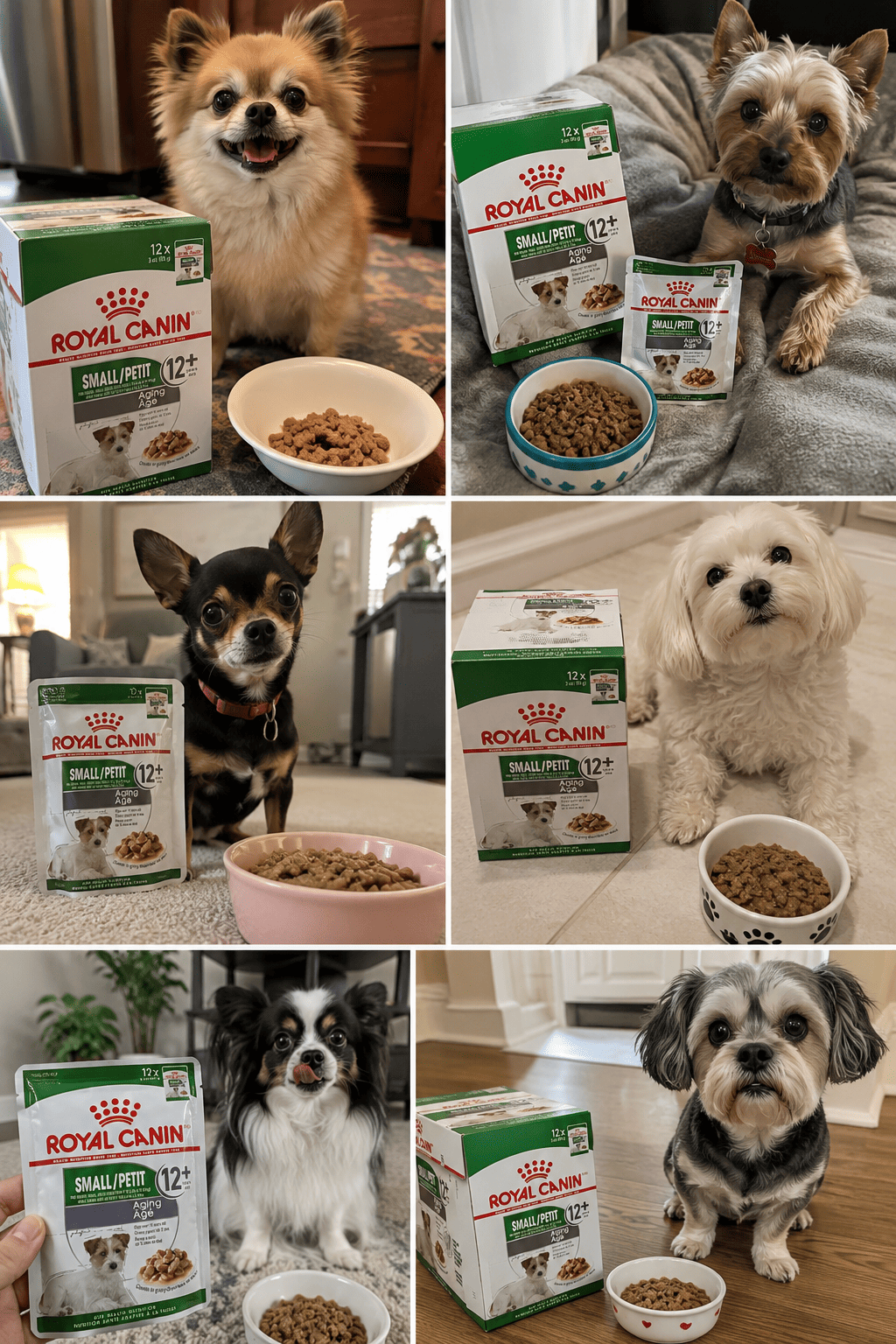
- Portion-sized specifically for small and toy breeds
- Soft texture designed for reduced chewing ability
- No opened-can waste — single-serve pouch
- Higher cost per ounce than large cans
- Less practical for larger multi-dog households
Why we picked it: it’s the most deliberately small-breed-and-aging-specific format on this list, built around portion size as much as texture.
Royal Canin builds its Size Health Nutrition line around a dog’s expected adult weight.
The Small Aging line targets exactly the intersection this article is about — small breed plus aging.
The pouch format means you’re not managing a half-used can in the fridge for a 6-pound dog who only eats a few tablespoons per meal.
That convenience comes at a higher per-ounce cost than a 13 oz can split across several meals — it matters more in a multi-dog home.
Confirm the current listing’s exact weight range and adequacy statement, since Royal Canin’s small-breed lines are segmented tightly by size and age bracket.
Hill’s Science Diet Adult 7+ Small & Mini, Chicken & Vegetables
Tray, 3.5 oz — verified current Amazon.com listing
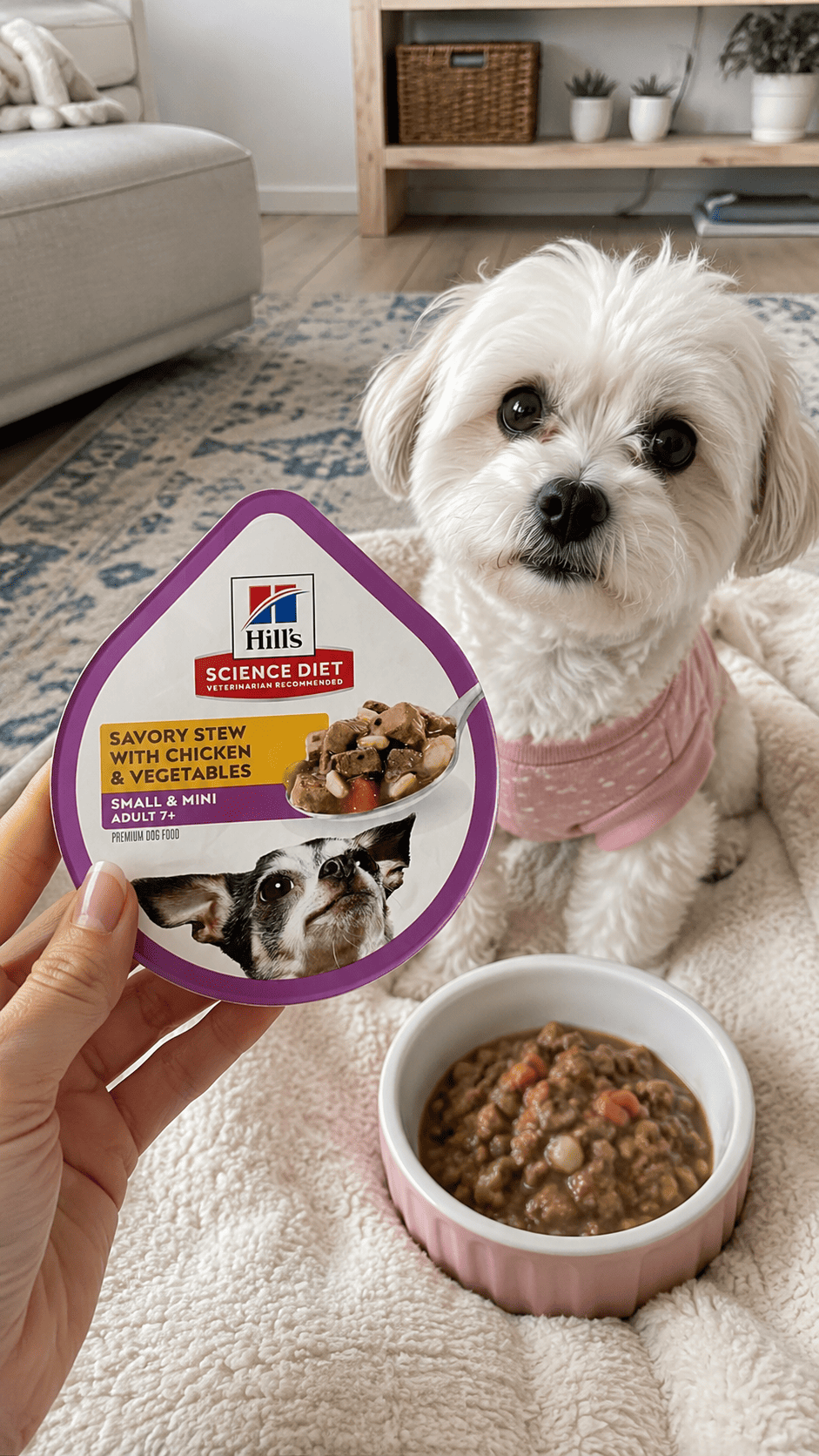
- 3.5 oz tray sized for genuinely small dogs
- Soft gravy-and-vegetable texture, easy to mash further
- Backed by Hill’s senior-specific nutrient research
- Higher per-ounce cost than large-format cans
- 12-tray cases require freezer or bulk pantry space
Why we picked it: the tray size solves the “half a can wasted” problem that shows up constantly with toy-breed seniors on standard 13 oz cans.
This is Hill’s small-and-mini-specific senior line, formulated for smaller mouths and smaller stomachs rather than a large-format recipe divided down.
The gravy-based chicken and vegetable dinner is soft enough that most reviewers describe minimal chewing required, though it isn’t a fully smooth loaf like Pick 1.
Per-ounce, trays cost more than large cans, which adds up over a case — worth it for many owners purely for portion accuracy and freshness.
Check the current listing’s calorie-per-tray figure against your dog’s target intake, since small trays can under- or over-feed a dog quickly if you’re not tracking it.
Hill’s Science Diet Adult 7+ Small Bites, Chicken Meal, Barley & Rice
Dry, 5 lb bag — verified current Amazon.com listing
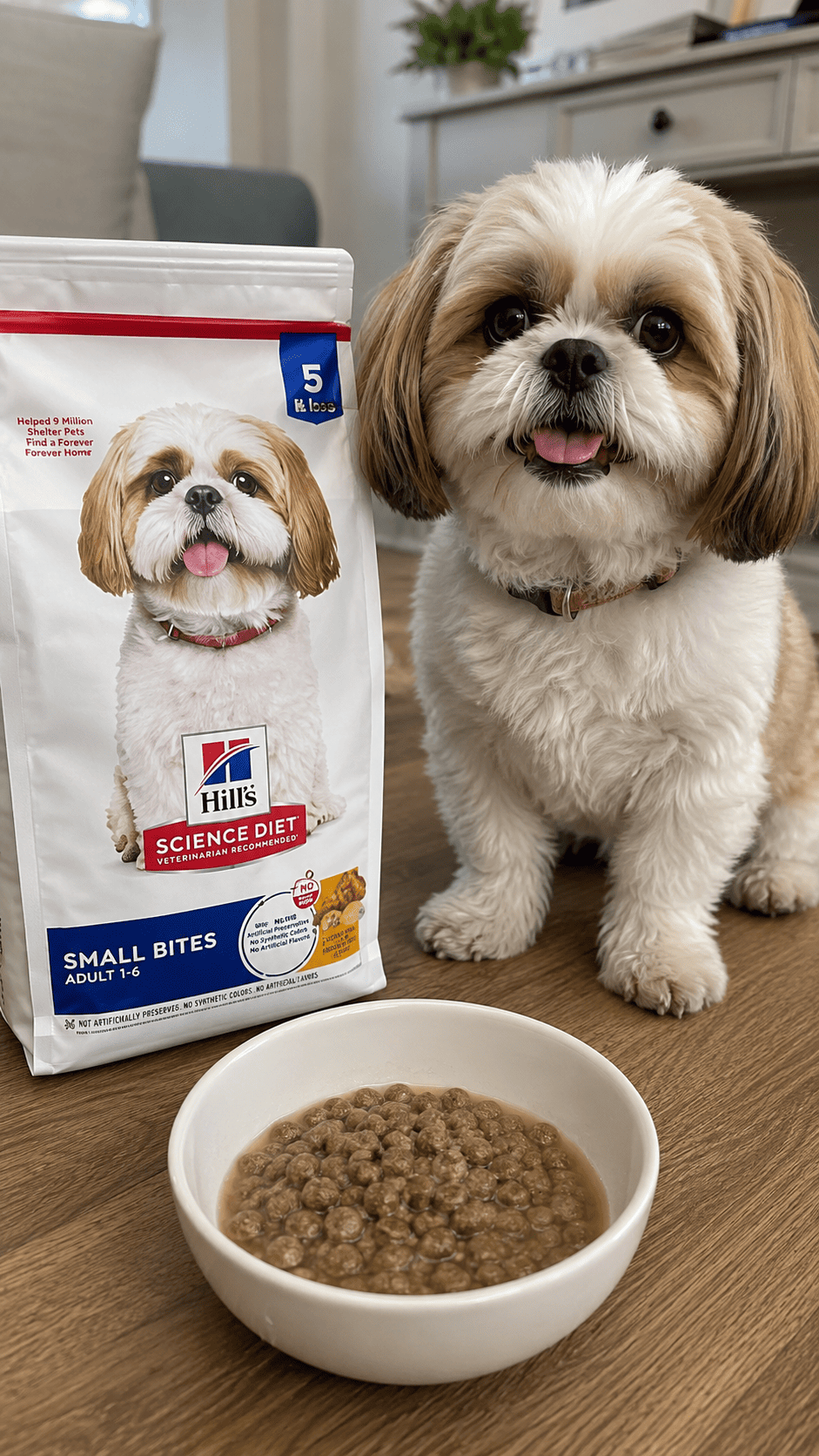
- Small kibble pieces are easier to manage than standard-size kibble
- Softens in a few minutes in warm water or low-sodium broth
- Dry format stores easily without refrigeration between meals
- Still requires some mashing/gum work even softened
- Not appropriate once chewing is genuinely painful
Why we picked it: it’s included specifically for the subset of “few teeth” dogs who aren’t toothless — owners who want the cost and convenience of dry food without abandoning it entirely.
Not every dog with “few teeth” needs full wet food — some simply need smaller kibble and a softening step.
Hill’s Small Bites formula is sized for smaller mouths and specifically designed to be easy to soften.
Small Bites kibble absorbs warm water into a soft, mashable consistency faster than standard large-kibble formulas — useful if you’re preparing meals on a schedule.
Softened kibble is still not equivalent to a smooth loaf. A dog with genuinely painful gums or very few teeth should move to Picks 1–6 instead.
Verify the current bag’s AAFCO statement and calorie-per-cup figure, and always let softened portions cool before serving.
- Start with a canned pate/loaf if chewing looks uncomfortable at all — no product on this list is a substitute for that judgment call.
- Match can/pouch/tray size to your dog’s actual body size, not just brand reputation.
- Softened kibble is a legitimate middle option only when several teeth remain and chewing isn’t painful.
- Joint-support formulas help a separate problem (mobility) — don’t expect them to fix a texture problem.
Practicality: Storage, Travel, and Portioning
| Format | Storage | Travel | Portioning | Typical Trade-Off |
|---|---|---|---|---|
| 13 oz cans (Picks 1–3) | Refrigerate after opening, use within a few days per label | Bulky for short trips | Often more than one small dog needs per meal | Leftover storage is the main friction point |
| 12.5 oz cans (Pick 4) | Same as above | Bulky | Similar over-portion issue for toy breeds | Same fridge-leftover trade-off |
| Single-serve pouch (Pick 5) | Shelf-stable until opened; no leftovers | Very travel-friendly | Matched to one meal, one small dog | Higher ongoing cost per ounce |
| 3.5 oz trays (Pick 6) | Shelf-stable until opened | Travel-friendly, easy to pack a few | Close to one meal for a toy breed | Cases take more pantry space than one big bag |
| 5 lb dry bag (Pick 7) | Sealed, cool, dry storage; no refrigeration needed dry | Very travel-friendly | Easy to measure by cup, then soften per meal | Softening adds a prep step at every meal |
A cheaper case of large 13 oz cans can end up costing more per feeding if a 7-pound dog only eats a third of each can and the rest goes to waste before it’s finished.
Before comparing sticker prices across these picks, check the current listing for calories per can, tray, or cup. Then estimate how much of that your specific dog will actually eat per meal.
Don’t rely on the “average adult dog” feeding guide on the label — it’s written for a wider weight range than most toy and small breeds fall into.
We haven’t published specific per-day cost figures here because current Amazon pricing shifts frequently. Check the live listing price against the calorie count at the time you order for an accurate comparison.
Five Things Most “Best Dog Food” Guides Skip
1. Myth vs. Reality: Soft Food and Senior Teeth
Wet food is automatically bad for a dog’s teeth, so switching means giving up on dental health entirely.
Neither wet nor dry food meaningfully cleans teeth the way brushing does.
A dog with few teeth left has little dental surface for kibble’s mild abrasive effect to work on anyway, so the “kibble cleans teeth” argument mostly stops applying once significant tooth loss has happened.
Dry kibble marketing has leaned on the “crunch equals clean” idea for decades, even though the effect is modest at best on healthy teeth.
Prioritize texture the dog can actually eat comfortably. Dental cleaning at this stage is a job for your vet, not the kibble aisle.
If a dog can still eat dry kibble at all, that means its teeth are fine.
Dogs are remarkably good at hiding dental pain — often swallowing kibble whole or eating on one side of the mouth rather than stopping eating altogether.
“Still eating” looks like “still fine” from across the kitchen, but it isn’t the same thing as comfortable chewing.
Watch for one-sided chewing, dropped kibble, or slower eating — not just whether food disappears from the bowl.
Senior dogs with few teeth all need low-protein food.
Current veterinary nutrition guidance doesn’t support a blanket low-protein rule for healthy aging dogs.
Protein needs are individualized, and restriction is only warranted for specific diagnosed conditions like advanced kidney disease.
Older “senior diet” formulations decades ago leaned low-protein by default, and the idea has outlived the practice.
Don’t filter out higher-protein senior formulas unless a vet has specifically flagged a reason to.
2. ADVANCED: Calorie Density Beats Cup/Can Comparisons
Comparing dog foods by “cans per case” or “cups per bag” hides the number that actually matters for a small senior: calories per feeding.
A 13 oz can with a lower calorie-per-ounce figure may require feeding nearly the whole can, while a smaller, calorie-denser tray delivers the same energy in a third of the volume — which matters a great deal for a dog with a small stomach and reduced appetite.
Wet and dry formats also aren’t directly comparable on the label. Dry food’s protein and fat percentages are reported at roughly 10% moisture, while canned food often runs 75–82% moisture.
So a wet food’s “8% protein” and a dry food’s “24% protein” aren’t describing comparably concentrated diets until converted to a dry-matter basis.
For an exact comparison: take (nutrient % ÷ (100 − moisture %)) × 100 for each food, using the moisture percentage from that product’s current guaranteed analysis.
3. “Few Teeth” and “No Teeth” Are Different Decisions
A dog with a handful of remaining molars can sometimes manage a softened small-kibble diet (Pick 7) that a fully toothless dog cannot.
Conflating the two leads owners either to over-restrict a dog who could handle more texture, or to under-soften food for a dog who genuinely needs a smooth loaf.
If you’re unsure which category your dog falls into, ask your vet to note exactly which teeth remain at the next visit — that single piece of information guides food choice more than any ingredient list will.
4. Multi-Dog Households: Feeding One Soft Diet Without Feeding Everyone Soft Food
When only one dog in the household needs a soft, senior-specific diet, separate feeding stations and supervised mealtimes matter more than the food choice itself.
Faster-eating housemates will happily finish a slow senior’s bowl. A senior eating a richer, protein-forward can (like Pick 2) also shouldn’t be sharing meals with a younger dog on a different nutritional plan.
Feed the senior dog in a separate room or crate for the first 15–20 minutes of each meal, until you’re confident the portion is being finished by the right dog.
5. When Common Advice Backfires
“Just add water to the same old kibble.” Sounds sensible, but standard large-kibble formulas often stay chunky even after soaking — that doesn’t help a dog with very few teeth.
The softenable Small Bites format (Pick 7) is built for this specifically, while a random large-kibble bag may not be.
“Switch to the richest, most premium can immediately.” A sudden jump from dry kibble to a rich, protein-dense canned formula can cause loose stool in a senior gut that isn’t used to that much moisture and fat at once. Transition over 5–7 days instead.
“Feed more since the food is softer and lower-calorie-looking.” Wet food often looks like “more food” by volume for the same calories as kibble, which can lead to accidental overfeeding and weight gain in a less active senior. Check calories, not cup or can volume.
“If one senior formula works, any senior formula will work.” Formulas vary meaningfully in texture, protein level, and added joint support — see the comparison micro-sections above before assuming interchangeability.
Advanced Decision Framework
-
1
Has a vet examined the mouth recently, or is this based on your own observation at home?No recent exam Book one before committing to a full case of any food — pain or infection changes the whole plan.Recently examined No urgent dental issue flagged — continue to the next question.
-
2
How many teeth remain, and where?Very few or none Start with a smooth loaf/pate (Picks 1, 3, or 4).Several molars intact No pain on chewing — softened small kibble is worth trying (Pick 7).
-
3
What’s the dog’s actual size?Under ~15 lb Prioritize small-portion formats (Picks 5 or 6) to avoid waste.15–25 lb Standard 13 oz cans (Picks 1–3) portion more efficiently.
-
4
Any other diagnosed condition — kidney, heart, joints?Diagnosed condition Confirm with your vet that this formula doesn’t conflict with a prescription need.Healthy, but stiff/less mobile Consider the joint-support pick (Pick 4).
What the Label Can and Cannot Tell You
What the ingredient list tells you: ingredient order by pre-cooking weight, the presence or absence of specific proteins or grains, and whether preservatives are natural or synthetic.
What it cannot tell you: digestibility, how well your specific dog’s gut absorbs the nutrients, or whether the texture will actually work for your dog’s mouth. That last part you can only confirm by watching a real meal.
Terms like “human-grade,” “holistic,” or “natural” describe marketing categories, not a guarantee of nutritional superiority. Always check the AAFCO statement for the actual adequacy claim rather than relying on front-of-package language.
Transitioning to a Softer Diet Safely
Abrupt diet changes can cause vomiting or loose stool in some dogs, and senior digestive systems are often less resilient to sudden change than a younger dog’s.
A general framework — noting that your vet’s specific instructions can differ — is to mix 25% new food with 75% old food for two days, move to a 50/50 split for two more days, then 75% new to 25% old before feeding the new diet exclusively.
Watch appetite, stool consistency, vomiting, and energy level throughout.
Contact your vet if vomiting persists beyond a single episode, if stool doesn’t normalize within a few days, or if your dog stops eating entirely for more than 24 hours.
If your dog has diagnosed kidney disease, heart disease, diabetes, or a history of pancreatitis, food choice should be guided by lab work, current medications, and the exact diagnosis — not by a general “best for few teeth” list.
Use this guide for comparison and discussion with your veterinarian, not as a substitute for their input.
For deeper reading on condition-specific formulas, see our guides to food for kidney disease and senior dogs with sensitive stomachs.
When to See a Vet About Your Dog’s Teeth and Eating
A soft diet is a management tool, not a substitute for veterinary dental care.
Book an exam if you notice bad breath that’s suddenly worse, visible tartar or red/bleeding gums, pawing at the mouth, dropping food repeatedly, unexplained weight loss despite eating, or reluctance to have the face touched.
For dogs recovering from extractions, see our guide on food after dental surgery for the short-term softer window before returning to a long-term formula.
If bad breath specifically is your main concern alongside texture, our guide to food that helps with bad breath covers that angle in more depth.
Cost, Value, and What “Best” Actually Depends On
None of the seven picks above is universally “best.” The right one depends on how many teeth remain, your dog’s exact body weight, whether a joint or organ condition is already diagnosed, and how many dogs you’re feeding at once.
If your dog is closer to toy-breed size, start with our toy breed feeding guide, or for breed-specific nuance this general list can’t cover, our Yorkie-specific no-teeth guide, teacup Yorkie guide, Maltese guide, or Shih Tzu guide.
If weight management is also a factor for a less active senior, our weight management guide goes deeper on that specific trade-off.
FAQ
01 Owner question What is the best dog food for older small dogs with few teeth?
A complete and balanced canned or pouch formula with a smooth pate or loaf texture, sized appropriately for your dog’s weight.
Hill’s Science Diet Adult 7+ Chicken & Barley is our top overall pick for texture and availability. The exception is any dog with a diagnosed condition that needs a prescription diet instead.
02 Owner question Can a dog with no teeth eat wet food safely?
Yes. Smooth pate or loaf textures require no chewing and can be lapped up with the tongue.
Press a small amount between two fingers before serving — it should flatten easily with minimal pressure and show no firm chunks.
03 Owner question Should I soften dry kibble instead of switching to wet food?
Only if your dog still has several teeth and chewing doesn’t look painful.
Soak small-kibble formulas like Pick 7 in warm water or low-sodium broth for a few minutes until soft, and let it cool before serving. Dogs with very few or no teeth generally do better on canned pate.
04 Owner question Do senior dogs need lower protein once they lose teeth?
Not automatically. Losing teeth is a dental issue, not a kidney issue, and current veterinary guidance doesn’t support a blanket low-protein rule for healthy aging dogs.
Protein restriction should be based on a specific diagnosis, not age or dental status alone.
05 Owner question How much wet food should I feed a small senior dog per day?
Check the calorie count on your specific product’s current label against your dog’s target daily calories, which your vet can help calculate based on weight and activity level.
Avoid relying on generic “cups per day” guides, since can and tray sizes vary widely between the brands in this guide.
06 Owner question How do I transition my dog to a new soft food without stomach upset?
Mix the new food in gradually over about a week — starting around 25% new to 75% old and increasing the new portion every couple of days — while watching appetite, stool, and energy.
Contact your vet if vomiting continues past one episode or stool doesn’t settle within a few days.
07 Owner question Is canned food more expensive than kibble for a small senior dog?
Often, yes — per calorie, especially in small-portion pouches or trays.
Compare cost against calories-per-container on the current listing rather than sticker price alone. A cheaper large can that goes half-wasted may cost more per actual feeding than a pricier, right-sized portion.
08 Owner question Does wet food clean a dog’s teeth the way dry kibble supposedly does?
Not really. Neither format meaningfully cleans teeth the way brushing does, and the effect of dry kibble on plaque is modest even in a full, healthy mouth.
For a dog with few teeth remaining, prioritize texture the dog can eat comfortably and talk to your vet about dental care separately.
09 Owner question What if my multi-dog household has one senior who needs soft food and others who don’t?
Feed the senior separately, ideally in a different room or a crate, for the first 15–20 minutes of each meal.
That way faster-eating housemates don’t finish their portion, and the senior isn’t eating a diet formulated for a different dog’s needs.
Key Takeaways
- Confirm how many teeth remain and whether chewing is painful before choosing a texture — “few teeth” and “no teeth” call for different formats.
- A smooth canned pate or loaf is the safest starting point for most dogs in this category.
- Softened small kibble is a reasonable middle option only when several teeth remain and chewing isn’t painful.
- Match can, pouch, or tray size to your dog’s actual weight to avoid wasted, spoiled food.
- Compare foods on calories per feeding, not cup or can volume, especially for weight-sensitive seniors.
- Don’t compare wet and dry protein percentages directly without accounting for moisture content.
- Transition gradually over about a week unless your vet directs otherwise.
- Seek veterinary guidance immediately for any diagnosed medical condition — this guide is for comparison, not diagnosis.
- A soft diet manages eating comfort; it doesn’t replace veterinary dental care for underlying disease.
Conclusion
There isn’t one single “best” food here — there’s a best match for the dog in front of you, based on how many teeth remain, how much they weigh, and whatever else your vet already knows about their health.
If you take one thing from this guide, let it be the two-finger softness test before you commit to a case of anything: press a small amount of food between your fingers. If it doesn’t flatten easily with no firm pieces, it’s not soft enough yet, whatever the label promises.
Feeding a senior dog well, at this stage, is less about finding a perfect product and more about paying close attention at each meal — which, if you’ve made it this far into a guide this detailed, you’re clearly already doing.
Shop This List
Related Guides
Choose the situation closest to your dog.


Leave a Reply